

I want to talk to you about something that sounds almost too simple to be interesting. A fabric. Specifically linen — and why I think you should know more about it. Hope I didn’t lose you already. 😊
As with anything else I encourage you to go do your own investigation and research to find out what you can and what matters to you, but here is some information that I found really interesting to get you going.
What Is Linen?
Linen is a natural textile made from the fibres of the flax plant — one of the oldest crops cultivated by humans, with evidence of linen production going back over many millenia.
Flax is a remarkably low-maintenance plant. The plant produces long, strong fibres inside its stalk and that is what eventually becomes the fabric we sleep on and wear.
What makes linen structurally different from other fabrics is something you can’t see: its fibres are hollow. That hollow structure is what gives linen its distinctive breathability, and it’s the starting point for most of linen’s practical health benefits.
Health Benefits
🌬️
Temperature regulation
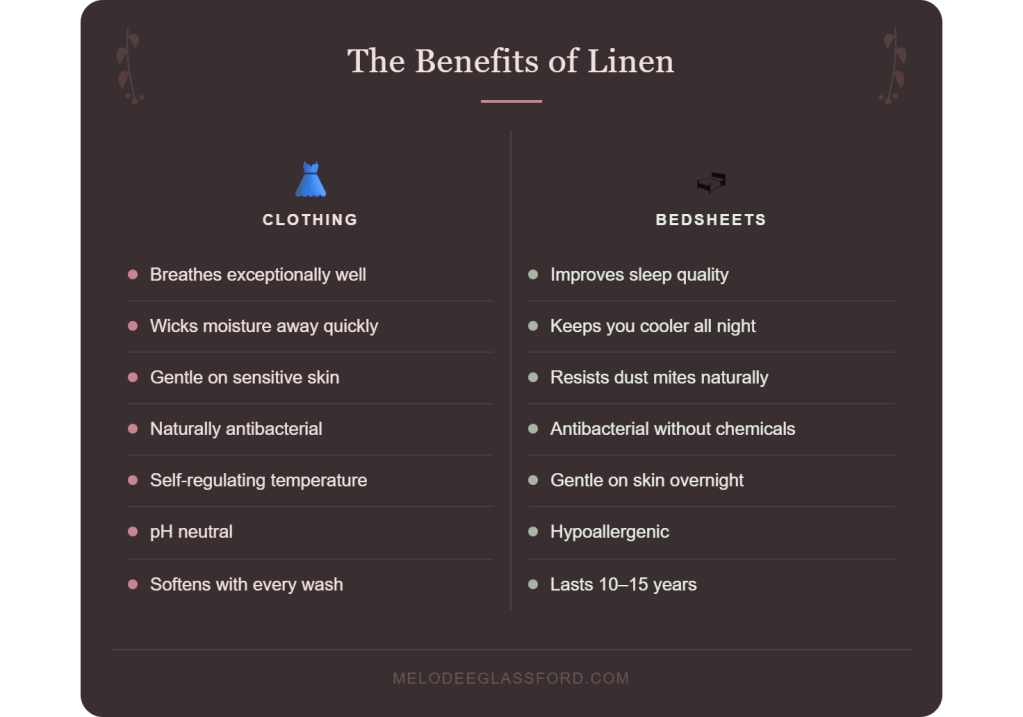
Because of its hollow fibre structure, linen allows air to circulate far more freely than most fabrics. Research shows linen allows up to 40% more airflow than cotton. This makes it genuinely self-regulating — cooling you in warm weather and providing gentle insulation in cooler temperatures.
💧
Moisture wicking
Linen can absorb up to 20% of its weight in moisture before it even begins to feel damp. It draws perspiration away from the body and releases it into the air quickly — faster than cotton, and dramatically faster than synthetics. This is what keeps you feeling dry rather than clammy.
😴
Better sleep
A 2024 systematic review in the Journal of Sleep Research found that linen bedsheets improved sleep quality under warm conditions — with fewer awakenings and less time in light-stage sleep compared to cotton-polyester blends.
🌿
Hypoallergenic properties
Linen’s natural fibres resist dust mites, bacteria, mould, and fungi — the main environmental triggers for allergies, eczema, and asthma. It doesn’t harbour allergens the way synthetic or heavily processed fabrics do. For people with sensitive skin, eczema, or psoriasis, linen is widely recommended by dermatologists as a gentler choice.
🦠
Naturally antibacterial
Linen fibres contain naturally occurring phenolic acids that inhibit bacterial and fungal growth without any chemical treatment. This is one of the reasons linen was historically used in hospitals for bandages and wound dressings — and it’s why linen clothing and sheets tend to stay fresher longer than synthetic alternatives.
✨
Skin health support
Regular contact with linen fabric provides a very gentle micro-stimulation of the skin that may support circulation and skin regeneration. Linen is also pH-neutral, which means it’s unlikely to disrupt your skin’s natural acid balance. It softens with every wash, and gets gentler the more you use it — which is not something you can say about most fabrics.
It also has a higher frequency value which supports your body’s energy level instead of taking away from it like synthetic fabrics do.
Your skin is the largest organ in your body. What it’s pressed against for eight hours every night — and dressed in every day — is not a small thing. And most of us have never thought about it that way.
We spend roughly a third of our lives in our beds. During sleep, our bodies do most of their repair and regeneration work. The environment we create in our bed — the temperature, the moisture level, the texture against our skin — affects the quality of that sleep, which affects literally everything else.
Under warm conditions especially, linen does better than cotton-polyester blends for the things that matter most for sleep: not as much waking up , less time in shallow sleep, and better temperature maintenance through the night. If you’re someone who runs warm, who wakes up damp, or who struggles through summer nights — linen sheets are worth taking a look at.
What surprised me, is that linen has what’s described as a very gentle “massaging” effect on the skin due to the tiny natural texture variations in the fabric. Over the course of a night, it may support circulation and skin texture in a way that smoother synthetic fabrics simply don’t.
And they get better with every wash. Linen softens over time — it starts slightly crisp and becomes increasingly supple and comfortable the more it’s used and washed. Many people who invest in quality linen bedding describe it as becoming like a favourite old worn-in thing over years of use. It’s just what the fabric does.
The same properties that make linen work for bedding make it work beautifully for clothing — especially if you’ve ever felt sticky and uncomfortable in synthetic fabrics during summer or warm weather.
Linen clothing breathes. Really breathes. The airflow through linen fabric is measurably higher than cotton, and dramatically higher than polyester or viscose. For anyone who struggles with overheating, skin sensitivities, or simply the discomfort of being too warm in their clothes — linen is worth exploring.
It’s also genuinely kind to sensitive skin. Linen’s natural fibres are less likely to cause friction irritation, less likely to trap heat against the skin (a major eczema trigger), and less likely to create the damp microclimate where bacteria and irritants thrive. Many people with eczema, psoriasis, or heat-related skin conditions find linen clothing significantly more comfortable than their alternatives.
People worry about linen being high maintenance. It’s really not. Just a few simple steps and you are good to go.
I’m not telling you linen is going to cure anything. I’m not telling you it’s magic. What I am telling you is that the fabric you sleep in and wear every day is one of those quiet daily choices that either works with your body or against it — and most of us have never thought about it that way.
Linen breathes. It regulates temperature. It wicks moisture. It resists bacteria and allergens naturally. It’s gentle on sensitive skin. It lasts for years, and it gets better the longer you use it.
As always — I’m not a doctor or an expert. I’m someone who has spent many years paying close attention to what goes in and on and around my body, and sharing what I find with you. I think linen is a great choice.
Have you tried linen bedding or clothing? I’d genuinely love to know what your experience has been. And if you haven’t — what’s stopping you? Let me know in the comments. 🌿

(Some readers have let me know they have been having trouble posting comments on my posts. I am working on figuring this out. Please let me know if you have trouble. Feel free to post comments on my social media platforms also. That really helps me. Thanks so much!)
Comment below with your thoughts about this or anything else. I would really like to hear your thoughts or your questions. Shoot me a personal message through the contact form on the site. I would love it if you like this enough to share it with others. Please SUBSCRIBE in the box above, it helps you know more of what’s going on.


No, we have never tried linen bedding or clothes – I guess it is worth trying for a better sleep!
LikeLike
It’s surprising how much of a difference they can make.
LikeLike